A multi-tenant AI platform that turns job discovery, fit analysis, evidence gaps, tailored applications and consultant support into one governed workflow.
Phoenix end to end: role discovery, multi-dimension fit scoring, evidence-gap analysis, tailored applications and where human judgement stays in control.
The problem
The first proof of concept was literally started on my phone while sitting in a caravan park on holiday. That is less a development methodology than an accurate description of how my brain works: if I can see the shape of a problem, I want to know whether the idea can work.
Job-search tools tend to split one human problem across multiple disconnected steps: find roles, decide whether they are worth pursuing, remember what the candidate has actually done, identify missing evidence, tailor documents, apply, then keep track of the process.
Phoenix treats that as one operating workflow. It aggregates roles, scores fit across multiple dimensions, adds salary and employer context where evidence exists, identifies gaps in the candidate's history, prepares role-specific documents and supports either self-directed or consultant-assisted applications.
The slightly cheeky bit
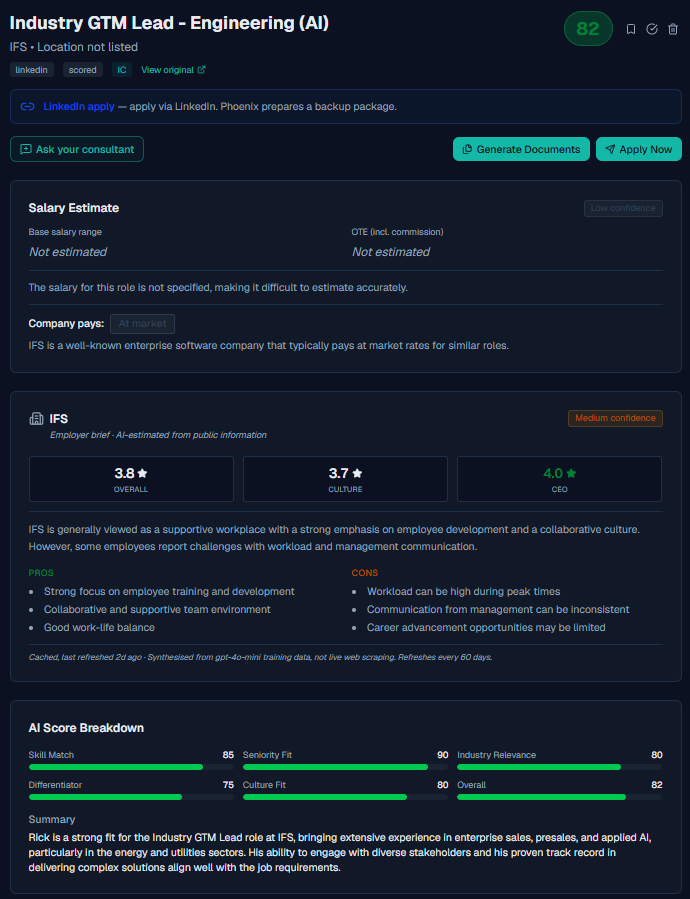
This screenshot is deliberately meta: Phoenix is analysing the same IFS Industry GTM Lead (AI) role that helped trigger this professional-site exercise.
The useful proof is not that Phoenix gave me a score of 78. An AI score is not a hiring decision. The proof is the workflow around it: evidence, uncertainty, gaps, context and a clear hand-off to human judgement.
The interface labels salary and employer information by confidence rather than presenting generated estimates as facts. A weak salary estimate remains “not estimated”; cached employer research is explicitly labelled as AI-estimated and time-bounded.
The workflow
DiscoverAggregate and normalise roles from multiple sources rather than relying on one job board.
AssessScore fit across skill, seniority, industry relevance, differentiation and culture rather than one opaque percentage alone.
AskBefore generating a résumé, run a gap scan and ask targeted questions when the job requires evidence that is missing from the candidate profile.
GenerateCreate ATS-compatible resumes and persuasive cover letters grounded in known career evidence and the actual job description.
ValidateUse a separate validation pass plus deterministic controls that cannot introduce new metrics, customers or credentials.
ActSupport application workflows while keeping the candidate or consultant in control of consequential decisions.
Architecture in practice
Phoenix is intentionally simpler than GNR8. The architecture chooses different models for different jobs and keeps deterministic controls around anything that should not be left to model judgement.
Scoring + analysisGPT-4o-mini handles high-volume structured job scoring and analysis.
Document generationClaude Haiku 4.5 via Vercel AI Gateway handles role-specific résumé and cover-letter generation.
PlatformNext.js, Vercel and Supabase provide the application layer, scheduled jobs, Postgres, authentication, storage and tenant isolation through RLS.
External servicesAdzuna and Greenhouse provide job data; candidate Gmail handles applications; Resend handles system email and digests.
Use the cheapest capable model for the routine work. Spend reasoning where the decision actually benefits from it.
Industrial AI translation
Phoenix demonstrates a different pattern: compare a requirement against a rich profile, identify what is missing, ask rather than invent, then generate an action from evidence that is actually present.
Phoenix patternRole requirement → candidate evidence → fit analysis → gap detection → clarification → tailored action.
Industrial translationWork requirement → technician or crew profile + certifications + location + experience + availability + job risk → fit assessment → escalate missing critical information → assign or recommend.
Missing information should create a question or escalation, not a confident guess.
Trust by design
Phoenix became another example of a theme running through my AI work: missing information should not be treated as permission to invent.
If a role asks for experience that is not already supported, Phoenix can surface that as a question. The candidate can add the missing context, save it for future use, use it once, or skip it. If they skip it, the system does not quietly manufacture the claim.
A better AI system is not one that always produces an answer. Sometimes the correct behaviour is to ask, decline or escalate.
Why it matters beyond recruitment
The recruitment domain is just the surface problem. The deeper pattern applies across enterprise AI: assemble the relevant context, evaluate it against an external requirement, identify what is missing, ask for clarification, generate only from supported evidence, independently validate the result, and keep a human authority boundary around the consequential action.