Contextual + Agentic Enterprise AI

Symphony

A live AI-powered deal-intelligence platform that started with a sales problem and became a broader laboratory for context, orchestration, voice, agents, institutional knowledge and verification.
2025-PresentContext orchestrationAgentsVoiceResearchTender intelligence
Walkthrough · 7 min
A guided tour of Symphony: portfolio deal health, the Value Alignment Model, stakeholder mapping, multi-source research and the event-driven meeting agent.

The problem

Complex enterprise deals increasingly fail because buying groups cannot align around a decision. CRM systems capture activity, but they do not necessarily help a seller understand the decision system itself: who matters, what each stakeholder values, where confidence is missing, and what must happen next.

What I built

Symphony became the environment in which I learned to turn that problem into working AI. It now spans contextual coaching, deal intelligence, stakeholder analysis, multi-source research, meeting preparation, realtime roleplay, voice interaction and institutional tender knowledge.
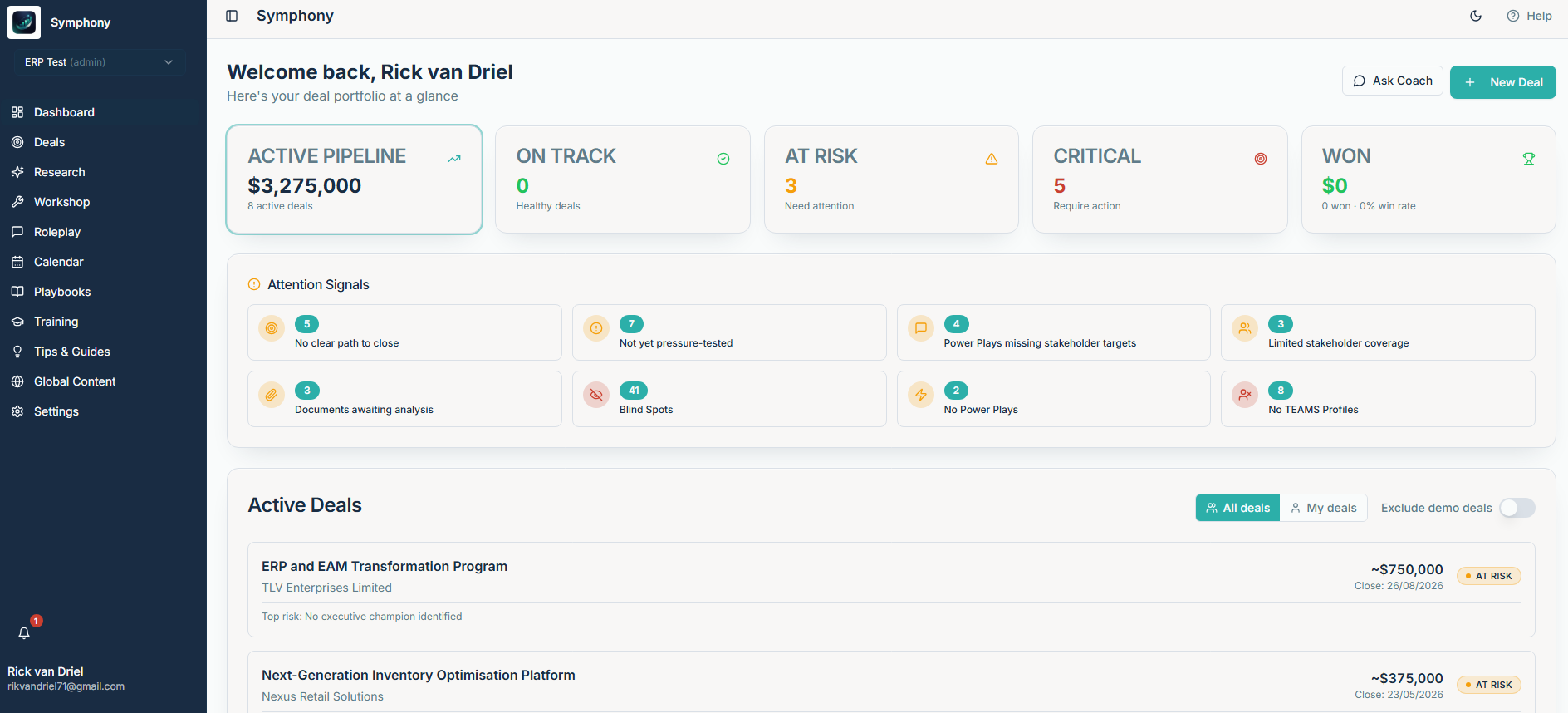
Symphony dashboard showing pipeline health and attention signals
Portfolio-level deal health and attention signals. The point is not more CRM reporting; it is surfacing where judgement and action are needed.
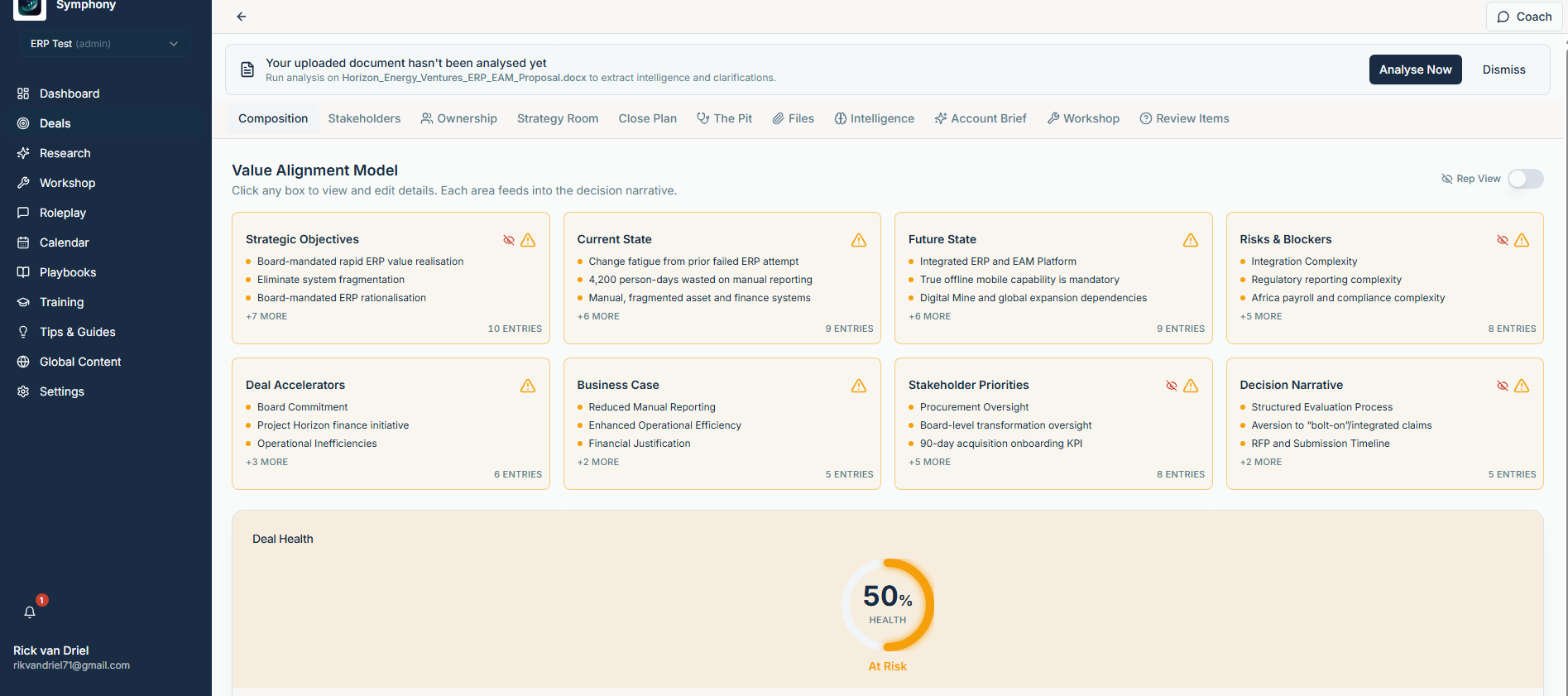
Symphony Value Alignment Model
The Value Alignment Model turns fragmented deal information into a structured view of objectives, current state, future state, blockers, business case and decision narrative.
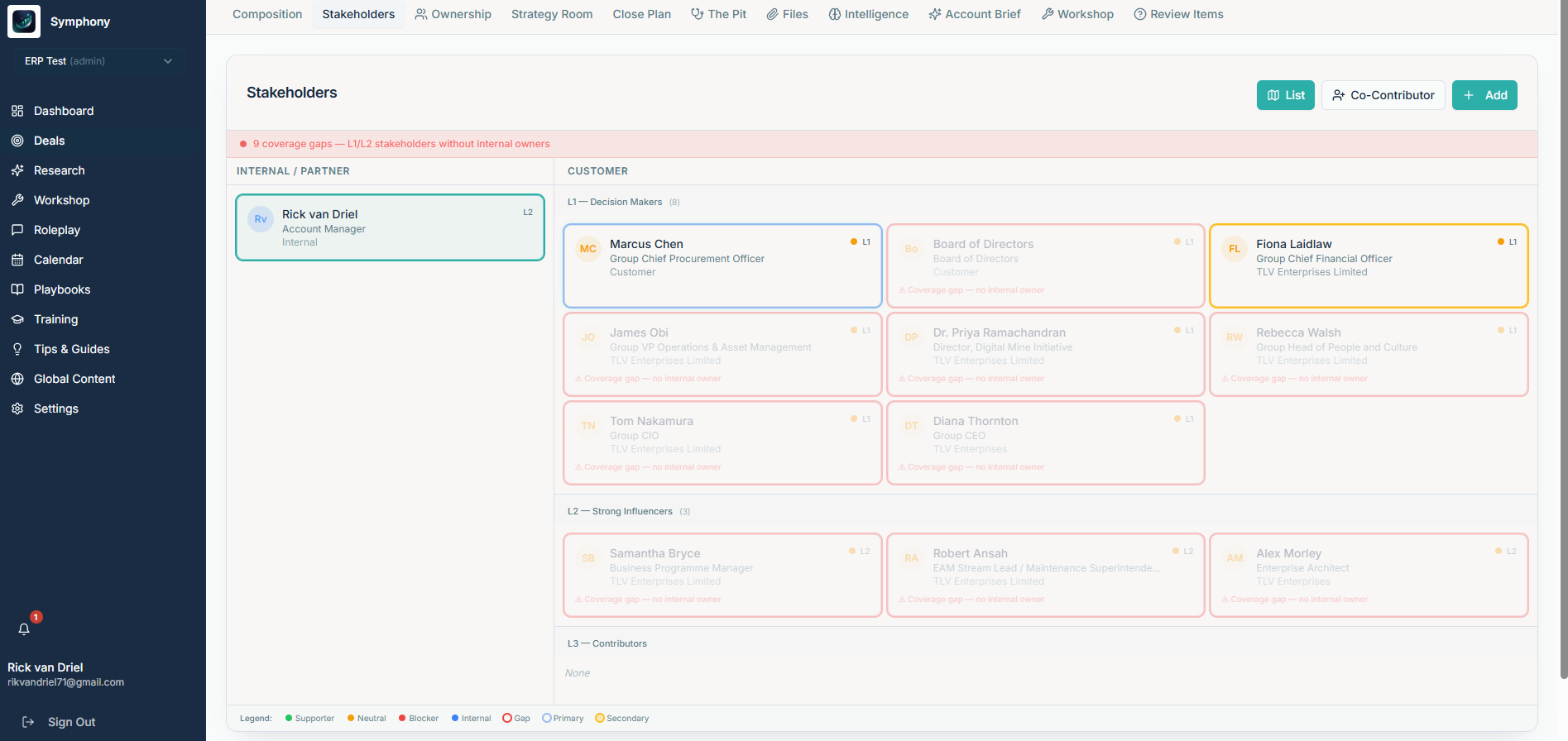
Symphony stakeholder map
Stakeholder mapping makes gaps visible, including missing internal ownership and unaddressed decision makers or influencers.
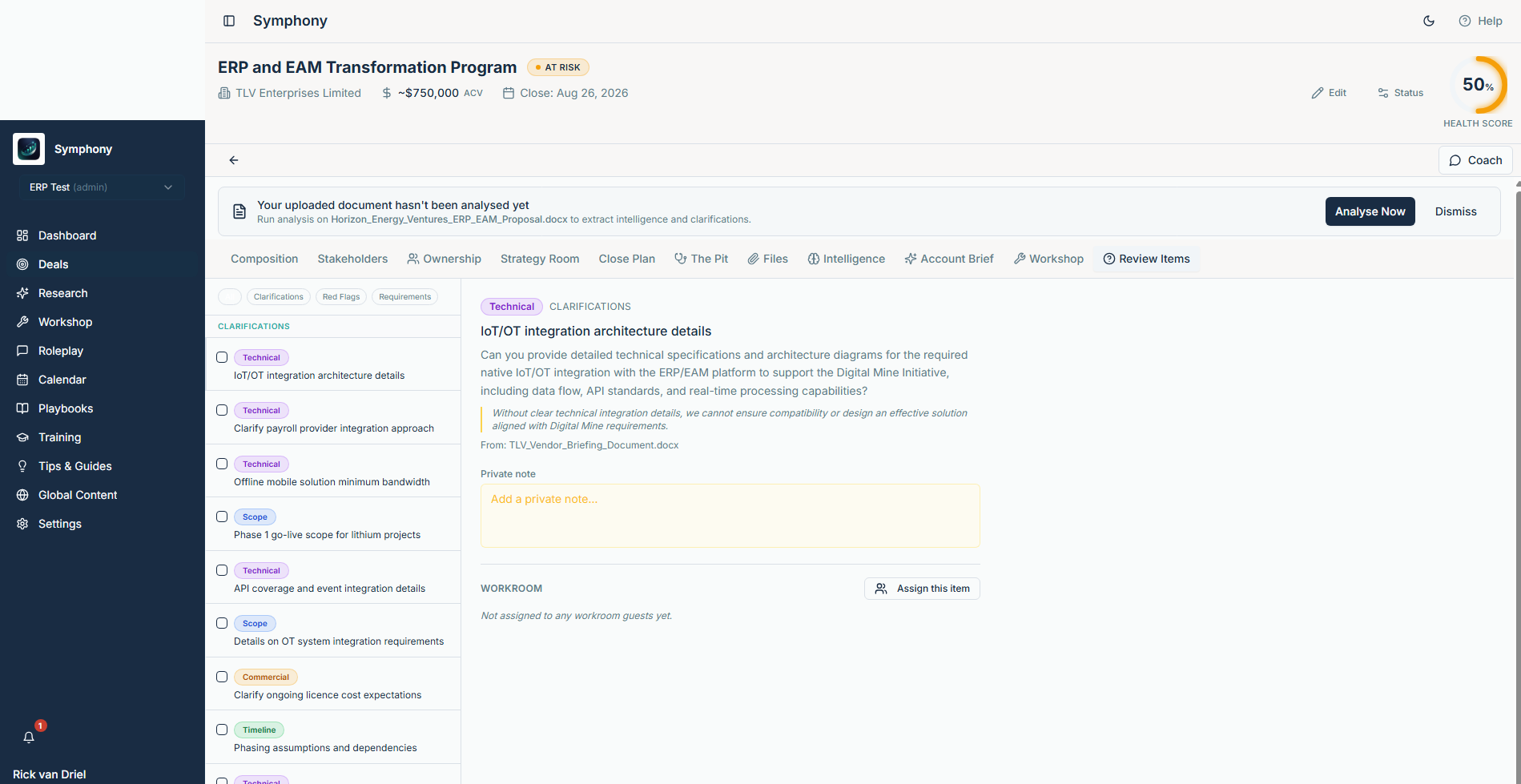
Symphony review items and clarification workspace
Document analysis surfaces clarifications, risks and requirements instead of pretending incomplete information is complete.

One example is an event-driven meeting agent that detects an upcoming meeting, identifies the people involved, assembles the relevant deal and stakeholder context, generates a meeting-specific briefing and distributes it to the appropriate internal participants.

Event → context → retrieve → reason → synthesise → create → distribute.

Architecture in practice

Symphony is deliberately not one model wrapped in one interface. Different workloads use different paths depending on whether the job is extraction, synthesis, research, coaching, retrieval or live conversation.

Reasoning + agentsOpenAI models and the Agents SDK support direct reasoning, structured extraction and retrieval against methodology knowledge where dynamic context adds value.
ResearchPerplexity research services and the reusable TSG Research Engine bring external account, competitor and industry context into the workflow.
Context + orchestrationSupabase, Deno edge functions and a Node/Express orchestration service on Render assemble deal, stakeholder and document context before model calls.
Enterprise contextMicrosoft Graph brings calendar and attendee context into event-driven meeting preparation and distribution workflows.
The model is selected for the workload. The workflow owns the outcome.

Switchable roleplay voice architectures

The roleplay environment also lets me compare two different conversational architectures against the same personas and evaluation logic. One path uses an integrated OpenAI realtime model. The other separates the conversational model from speech and uses Deepgram Flux for the voice layer.

I have kept both behind a switch rather than forcing an early winner. That allows latency, turn-taking, conversational quality and cost to be tested without redesigning the underlying roleplay workflow.

Industrial AI translation

The domain is sales, but the underlying pattern is not. Symphony takes an event or question, assembles the relevant operational context, reasons over it and turns the result into something a person can act on.

Symphony patternMeeting or deal event → documents + stakeholder context + history → reasoning → briefing, recommendation or next action.
Industrial translationAsset anomaly → maintenance history + open work + manuals + spares + crew + operational risk → recommended intervention → route it to the right people.
The transferable capability is context orchestration around a decision, not sales software.

What became reusable

As the system grew, some capabilities stopped being "features" and became reusable building blocks. The research engine was extracted into a shared package. Tender intelligence became its own evidence-and-confidence problem. Roleplay required state, persona control and separate evaluation. Assurance work emerged because increasingly capable agents needed stronger controls.

See the public product

Open symphonyhq.ai

Back to profile