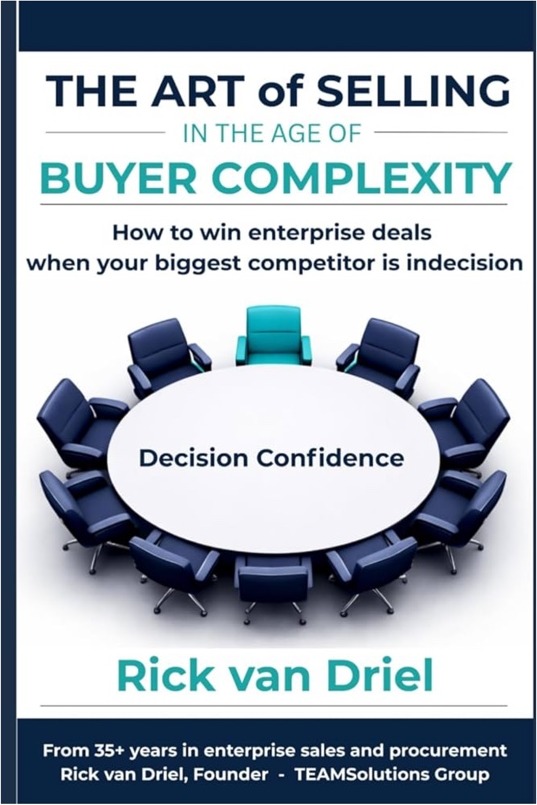
The deals that were lost before they started
The book grew out of a pattern I had seen repeatedly across complex enterprise selling and from time spent on the buying side: apparently good deals were dying without a competitor actually beating them. The business case could be sound, the product could fit, the champion could be supportive, and the buying group could still fail to reach a decision.
That observation led to the idea at the centre of the book: Decision Confidence. A buying group moves when enough stakeholders can see enough clarity around value, alignment and risk to commit without unacceptable personal or functional exposure.
From selling to orchestrating
The book argues that modern complex selling increasingly requires the seller to become an orchestration partner: someone who can see across the decision system, surface fragmented concerns, help stakeholders understand one another's priorities and create the conditions in which the organisation can actually decide.
This is not about becoming softer or more passive. It is about being harder to displace because the seller is contributing something a competing pitch cannot easily reproduce: decision clarity across the whole buying group.
Five parts, one progression
The intellectual architecture
The book is intentionally practical. Its frameworks are designed to help a seller progressively build and read a picture of the decision rather than simply qualify a sales opportunity.
The Value Alignment Model is particularly important. It is a deal-intelligence map rather than a slide framework. It connects strategic objectives, current and future state, blockers, accelerators, business case, stakeholder priorities and the decision narrative into one evolving picture.
AI should extend judgement, not replace it
One chapter deals specifically with AI as an orchestration accelerator. The argument is not that sellers need more generated content. AI becomes useful when it helps them perform the difficult synthesis that rarely scales manually across an entire portfolio: research, stakeholder mapping, concern anticipation, narrative preparation and contextual briefing.
That principle has subsequently influenced almost everything I build with AI: use models where reasoning creates value, and use software, evidence and human authority where certainty matters.
Experience → pattern → method → book → Symphony
Symphony is where the methodology became software. The same Value Alignment Model described in the book is populated from deal information; stakeholder intelligence connects people, priorities, authority and risk; and the broader platform turns the accumulated context into deal analysis, research, meeting preparation, roleplay, coaching and action.
That relationship matters to me because it demonstrates the way I prefer to work. Start with the operating problem. Build an intellectual model that explains it. Test the model against real situations. Then use technology to make the capability repeatable and usable at scale.